What is Upsalite®?

Upsalite® is the first and only mesoporous magnesium carbonate — a patented, multifunctional powder invented at Uppsala University, Sweden. One gram holds around 500 m² of internal surface area, which lets it absorb oil and moisture inside its pores instead of on the particle surface.

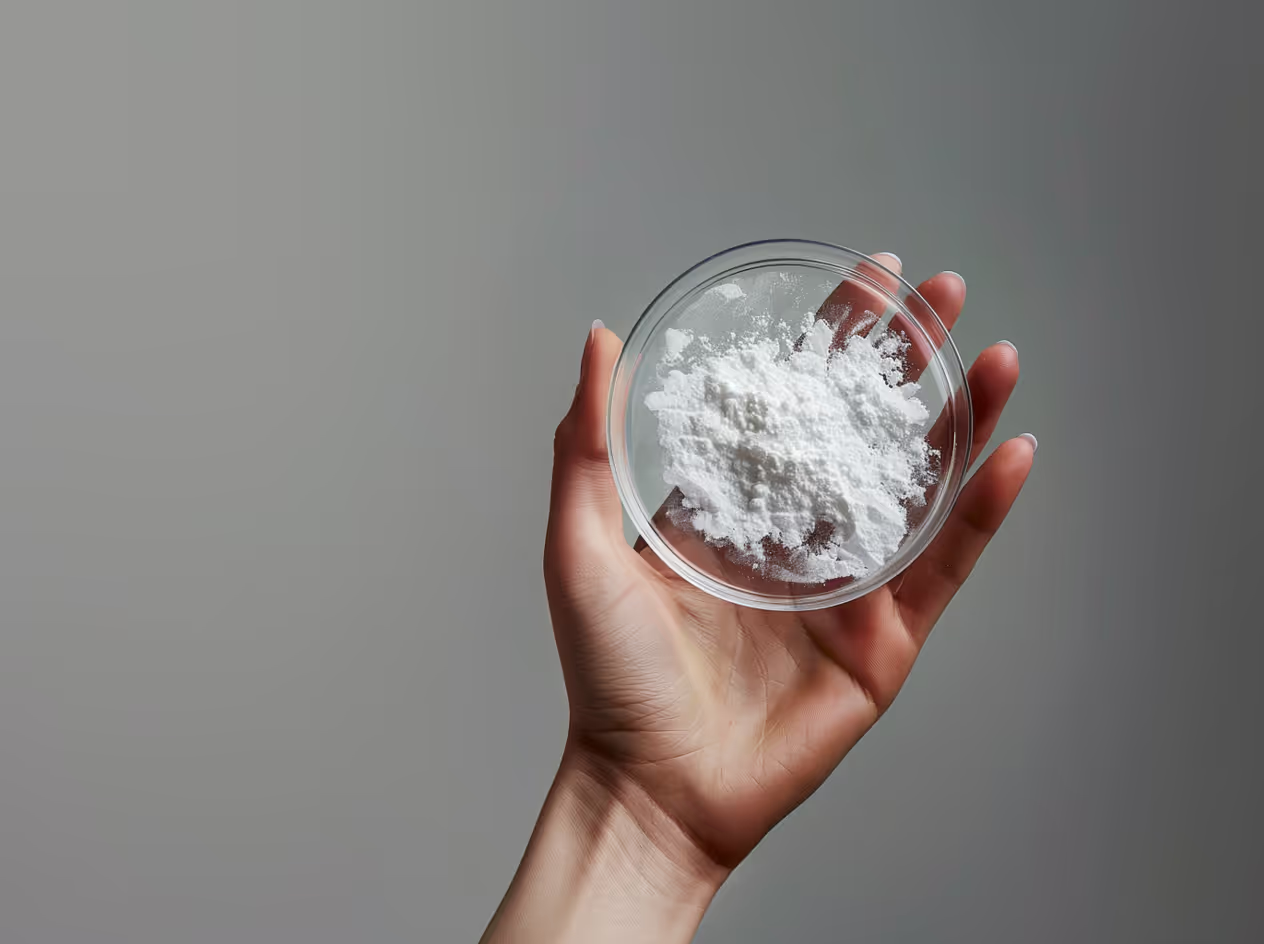
A hand holding a petri dish of white Upsalite® powder

What makes Upsalite® unique?

The secret is in the pores. Four properties separate Upsalite® from every other absorbent powder in use today.

01

Superior absorption

A pore volume of more than 0.5 cm³/g enables significantly higher oil and moisture uptake than commonly used ingredients.

02

Internal pore capture

Absorbs oil and moisture within its porous network — not just on the particle surface, where traditional powders stop.

03

Dual affinity

Captures both hydrophilic (water, sweat) and lipophilic (oil, sebum) substances simultaneously.

04

Light diffusion & adhesion

Its irregular architecture scatters light for a soft-focus, blurring effect — and adheres to skin better than spherical particles like silica.

How does the science work?

Upsalite® is a synthesized amorphous, mesoporous magnesium carbonate with millions of pores per particle, a narrow pore size distribution centered between 3–6 nm, and an extraordinarily high surface area of around 400–500 m²/g. Under an electron microscope the difference is visible: oil disappears into the porous network while conventional powders carry it on their surface.

SEM images comparing Upsalite® (MMC), silica, kaolin, talc and corn starch before and after oil exposure
SEM — particles before and after oil exposure

How does Upsalite® compare?

Upsalite® absorbs inside its porous structure; conventional powders absorb on the particle surface. That single difference drives capacity, speed and skin feel.

Upsalite®TalcSilicaMicaCornstarchKaolin
Absorption mechanism Inside the porous networkSurface onlySurface onlySurface onlySurface, swellsSurface only
Oil absorption time* ~5 min~6 min~61 min~15 min~4 min
Absorbs oil + sweat simultaneously YesNoPartialNoPartialNo
Soft-focus / blurring effect Yes — light-scattering architectureModerateLowShimmerLowLow
Surface area ~400–500 m²/gLowHighLowLowLow
Microplastic-free mineral YesYesYesYesYes (starch)Yes

Comparison values from internal lab testing and published literature; to be reviewed before publication. Long-term, each comparison gets its own page (/compare/talc, /compare/silica …).

Macro photograph of Upsalite® material

Why was it called impossible?

For over 100 years, researchers tried and failed to synthesize a porous form of magnesium carbonate. In 2012, Professor Maria Strømme and her colleagues at Uppsala University's Division of Nanotechnology & Functional Materials invented it — serendipitously, during pharmaceutical research. The result was named after the city: Upsalite®, the impossible material made possible.

What are the material specifications?

  • INCIMagnesium carbonate
  • Chemical nameAmorphous mesoporous magnesium carbonate
  • AppearanceWhite, finely milled powder
  • Surface area~400–500 m²/g
  • Pore sizeNarrow distribution, centered 3–6 nm
  • Key functionsAbsorbent, mattifying agent, blurring agent, anti-caking, texture modifier, rheology modifier
  • ApplicationsPrimers, setting & finishing powders, foundations, concealers, eyeshadow, setting sprays, chamois & anti-chafing creams, dry shampoo, deodorant

COSMOS approved

Upsalite® (C101) is verified by ECOCERT GREEN LIFE, compliant with the COSMOS Standard and without animal origin (F363(COS)v09, issued 02/11/2021).

Natural origin

Natural Origin Index of 0.99 per ISO 16128-2 2017 — a Derived Mineral. Available with a Natural Origin Index of 1.00 by request.

Not a nanomaterial

Not classified as a nanomaterial under EU and US regulations, determined by a Tier 2 analytical method.

Frequently Asked Questions

01What makes Upsalite® unique?+
The secret is in the pores: Upsalite® is truly a multifunctional ingredient with a narrow pore size distribution, and a high surface area which enables superior simultaneous absorption of lipophilic and hydrophilic substances such as sebum and sweat. The porous structure gives Upsalite® the ability to absorb more than other commonly used ingredients in addition to scattering light and increasing adhesion to skin.
02Is Upsalite® natural?+
Upsalite® has a Natural Origin Index of 0.99 and as such is considered a Derived Mineral according to the definition in ISO 16128-2 2017 (Criteria for ingredients and products). Upsalite® can be made with a Natural Origin Index of 1.00 by request.
03Is Upsalite® a nanomaterial?+
Upsalite® is not considered a nanomaterial according to EU and US regulations. It has a particle size distribution where less than 50% of the particles are sized below 100 nm, determined by a Tier 2 analytical method. Additionally, it is neither insoluble nor bio persistent, which aligns with the EU definition of a nanomaterial.
04Is Upsalite® COSMOS approved?+
Upsalite® (C101) is a raw material verified by ECOCERT GREEN LIFE, compliant with the COSMOS Standard and without animal origin (F363(COS)v09, issued 02/11/2021).
05Can Upsalite® be used in aerosols?+
Yes, Upsalite® is approved and already used in various aerosol products.
06Does Upsalite® work with any type of formula?+
Upsalite® is compatible with anhydrous or water-free formulations. It works well with both dry and liquid anhydrous binders and is compatible with high pigment levels, providing a smooth, natural finish with shine control and sheer coverage. It is not recommended for use in water formulations as its structure attracts water, which can lead to crystallization and degradation of the porous structure over time.
07How do I get a sample of Upsalite®?+
Material samples are provided to brands and formulators by Disruptive Materials. Please submit a request via the contact button — we are ready when you are.


Still have questions?

Can't find the answer you're looking for? Our expert team is one call away.

Contact us
About Upsalite® — What is the impossible material?